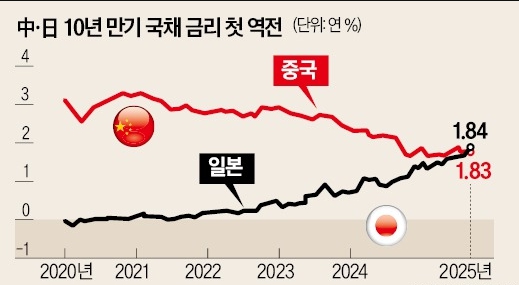
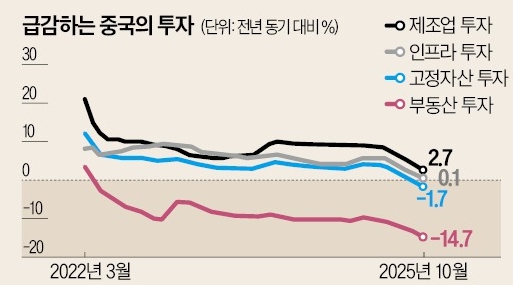
According to Japan's Nikkei Shimbun (Nikkei), China's 10-year government bond yield is in the 1.83% range per year, which is lower than Japan's 10-year bond yield (around 1.84% per year). Since statistics began in September 2000, the 10-year yields of the two countries have reversed, and this is the first time the 10-year government bond yield has reversed. The 10-year government bond yield is the benchmark for the government bond market, while the 30-year and 20-year government bond yields were higher than China's, and this reversal has now spread to the 10-year government bond . China The 10-year Treasury yield has been hovering near its lowest point for over two months, as major economic indicators such as slowing economic growth have fallen short of expectations, prompting investors to shift their funds to the relatively safer Japanese Treasury bonds. A Decade Between China and Japan The reversal in maturing government bond yields clearly shows the opposite economic conditions in both countries. China remains struggling to escape the deflationary crisis amid sluggish domestic demand, and the Producer Price Index (PPI) in October fell 2.1% year-on-year, continuing its decline for 37 consecutive months,,,, On the other hand, Japan's Consumer Price Index (CPI) rose around 3%, indicating inflation levels higher than those in Europe and the United States. As a result, China is facing a real estate market downturn, sluggish domestic demand, and slowing exports. While Japan is entering a prolonged recession similar to the past, Japan is attempting to escape the long-term deflation (falling prices amid economic downturns) known as the 'lost 30 years' following the real estate bubble burst. Bloomberg News explained, "Investors are now reflecting a structural shift in prices: China is taking over the role of the prolonged recession Japan once experienced, while Japan is emerging from decades of deflation."
Comments 0
Log in to comment.