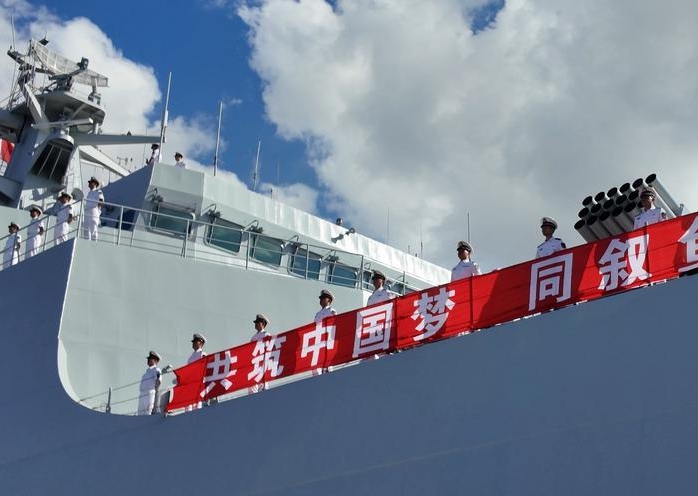
Recently, after the Australian Defence Force (ADF) detected that Chinese naval vessels were approaching nearby Australia, the entire Indo-Pacific region reacted sensitively. Although it appears to be a long-range Chinese exercise, some Western intelligence agencies ,,, interpret this move not as a simple long-distance voyage but as an analysis of the maritime data networks and communication routing structures concentrated around Australia. China's naval forces operating outside the Second Training Line are routinely deployed even in peacetime. As the trend of deployment solidifies, data and communication networks connecting the sea are emerging as a new 'battlefield.' China has regarded the area around Australia as the 'southern flanking axis of the U.S. Navy,' and last year, there was even an incident where the Chinese navy conducted military radar surveys near the Australian Exclusive Economic Zone (EEZ). In particular, China's real aim is not to display military threats, but to establish patterns in maritime communications and surveillance networks in the Indo-Pacific that extend from northern Australia to Guam and Japan. There is analysis that this is the pattern of surveillance networks. China's long-range electronic intelligence acquisition (ELINT) and communication interception equipment can detect specific frequency spectrums, AIS modulation patterns, communication routing flows, and changes in submarine cable signals even while operating in peacetime navigation mode . They can detect it. This is an 'invisible clash' on a completely different level from wartime ship-to-ship clashes, and it corresponds to a strategic preparation stage where the enemy's eyes, ears, and command systems are analyzed in advance to gain data superiority. China truly strives hard!!!!!
Comments 0
Log in to comment.